

Information for the New Shepherd
Welcome to the job of being a shepherd! Getting your first sheep is not complicated, but there are a few things that can catch you out if nobody tells you about them first. This page covers the basics — foot care, worms, vaccination, and a few rumen issues that are worth knowing about before they happen rather than after. We have linked to a lot of resources that we think are great, and there is a mountain more out there – the below is intended to act as a window into the key issues and husbandry jobs you should know to start. Most importantly – we are not vets, and any experienced sheep person will tell you the learning never really stops. Every animal is different, and living remotely with livestock and with help far away has taught us that as much as anything. However this has also meant learning the critical fundamentals — thanks to a decade of extraordinary mentors and a fantastic veterinary support team. Knowing what to look for, what’s normal, and what makes the day-to-day a lot easier makes your start in sheep much easier. As you progress in your sheep keeping you will be able to spot potential problems well before they progress, and the management jobs below will become second nature. If something looks serious, or beyond your capability at the time – call a vet. Otherwise, keep up with the jobs and watch out for the potential issues/signs below and enjoy your sheep!
One thing worth saying upfront: if you’re starting with Damaras, you’re already ahead in a few ways. They are a resilient breed, and will be more forgiving for minor management errors than many other breeds – arguably even goats. They don’t need shearing. They shed their fleece naturally, which removes one significant management task and one significant cost. Also, lacking a heavy fleece any cuts or skin issues are readily noticeable. Their parasite resistance is also better than most breeds — not immunity, but a meaningful advantage that shows up in practice – more on that below. Also, feel free to touch base anytime. We had great mentors who supported us at our start – and beyond – and that phone call or chat was priceless – we would be happy to offer the same.
A Note on Lambing – We’ve deliberately left lambing out of this page. There’s too much to cover here, and the decisions involved (whether to lamb, when, how intensively to manage it) and the medical care required depends heavily on your situation, your experience, your setup and your goals.
FOOT CARE
Sheep feet need regular attention. Left unchecked, overgrown hooves cause lameness, and lame sheep lose condition quickly. How often you need to trim depends on your country and your individual sheep. Hard, rocky ground wears hooves down naturally. Soft, wet country means faster growth and more frequent checking and trimming. Here, with a wide range on granite hills and rocky riverbeds, we eyeball feet every four months, and really only need to manage the ram hooves who spend their time on the sandy flats.
What you need: A pair of sharp hoof shears or secateurs for the job. Cetrigen (or similar) and styptic powder. An extra pair of hands to hold the sheep, or a way to restrain them while you are working.
What you’re looking for: Hooves that have folded over, curled, or packed with dirt or grown long in the toe. A healthy hoof is compact and reasonably flat on the sole, the base line following a similar line to where the hoof joins the foot. Any redness, inflammation or irritation between the toes.
What you’re doing: After cleaning off the hoof, trim the outer horn, long toe sections, and the soft heel bulb. Don’t cut into live tissue, which bleeds and causes pain – go slow, and have some centrigen (or something similar) and styptic powder on hand just in case. A tiny pinpoint bleed is not an emergency – but something larger can leave your sheep sore and open to infection.
Keeping on top of your hooves mean small manicuring sessions, rather than a big tricky job. The diagram to the right is for goats – but the principles are the same. Three good YouTube videos are from the SDSU Extension Demonstration (skip to 2.50), the Shear Goodness Trimming Explanation and for some trickier hooves, an accidental cut into live tissue plus information about foot bathing on Care Tips from a Vet video.
Foot scald and foot rot are two serious foot diseases to know about. We have fortunately never seen them here, so can not offer any first hand advice – but for great information – check the DPI website section on Footrot in Sheep.
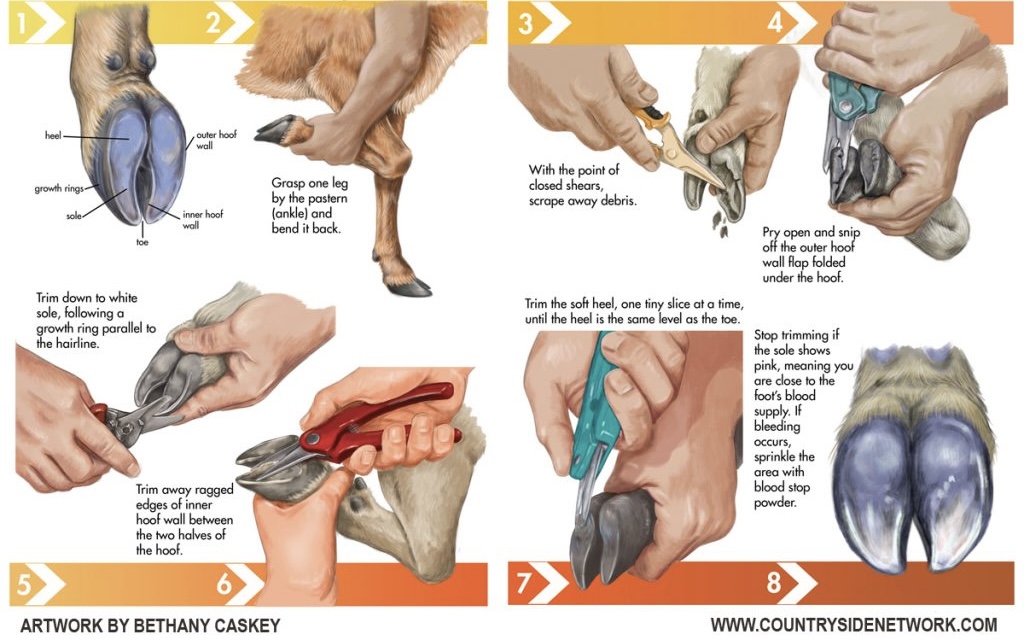
The above image is from the countryside network website
Both diseases spread between animals, so if you are , isolate any sheep that’s limping until you know what you’re dealing with. If a sheep is suddenly and severely lame with no obvious hoof issue or disease, consider other causes — such as an injury, sprains – or often something simple like a burr or grass seed between the toes. If you don’t know – call the vet.
INTERNAL PARASITES
Damara have a well-documented advantage in parasite resistance compared to most British and European breeds. This doesn’t mean you can ignore worm management — it means your Damaras will, on average, carry lower burdens under the same conditions and require less frequent intervention than those breeds would. In practice, some individual animals will still need treatment; the breed advantage shows up across the flock, and not always in every individual. Good studs will not breed from animals that display subpar resistance.
The worm conversation can be detailed and complex – there are lots of management practices, best drenching practices and a huge volume of information out there. If you love to go into detail and learn about these things, worm life cycles, pasture rotation, drench resistances, refugia …we are going to point you to the Worm Boss site, and it may be worth checking our parasite management on smallholdings section. But for those that just need the toppling action plan, keep reading below.
Barber Pole worm (Haemonchus contortus) is the main threat to sheep here in NSW, particularly in warm, wet conditions, and so this is what we will focus on. It lives in the stomach, feeds on blood, and can kill animals quickly if the population gets high enough. The important thing to understand is that not every animal in your flock will need drenching at the same time. Over-drenching is how resistance develops — and drench resistance is a serious, growing problem in Australian sheep farming. The current best practice is to drench the animals that need it, when it is proven they need it, with alternating drench classes – not the whole mob on a calendar schedule. For the absolute best information on management, visit the Worm Boss website.
What you are looking for: The signs you can see are lethargy, bottle jaw (fluid accumulation under the chin), pale gums, and sudden deaths in severe cases. A sheep can be in good condition, not scouring, and still die suddenly from Barber Pole burden. They are most active in warm, humid conditions – spring – autumn, and numbers can build rapidly if sheep are in the one paddock continuously.
What you need: FAMACHA checks, FEC’s (Fecal Egg Counts), Drench and drenching equipment.
FAMACHA is a practical in paddock, quick check or drench decision method. It is a scoring system based on the colour of the lower eyelid — pale means anaemic, which means the worm burden is high. Head to this Small Ruminant Parasite Control page for information and training videos. It takes a few minutes per animal once you’re used to it, and it can help decide if and when to drench.
FEC’s are performed by your vet (or someone with a high power microscope and the knowledge of what they are doing) are the most accurate way to determine your sheeps actual worm burden – they test for multiple worm species and are precise when something like FAMACHA is more of a guide. All you need to do is collect some fresh pellets, keep them cool and get them delivered! A few pellets from each sheep can be mixed together for a flock picture.
Beyond this, you will need sheep suitable drenches, preferably of different chemical classes. When you only have a few sheep, it will be much more economical to source a few doses from your vey when needed – this will allow you easy access to different classes and in date product. A drench gun is handy – but again, with only a handful of sheep, a syringe will do fine.
What you are doing: If your FAMACHA check or FEC count has returned that you have a high BarberPole burden, you probably need to drench. Make sure the quantity of drench is correct for the sheep – underdosing is as problematic as large overdosing. Follow the product label exactly. Calmly restrain your sheep and insert the drench gun or syringe into the side of the mouth, and over the back of the tounge. Avoid as much stress as possible top prevent accidental aspiration – and watch out for “spitters” – sheep who will spit most out rather than swallowing! Keep these sheep contained for a day or two – then move to clean or low level paddock. Again – for more in detail information, guides and much more, head to the Worm Boss site. It’s a recommended read.
There are very effective practices that will help to control worm burdens that do not rely on drenching alone – pasture management, rotational grazing, Biowormer products, multi-species grazing or cell grazing to name a few. We will get to linking more information sources on these soon, because we think they are great – keep an eye out!
VACCINATION
The basic vaccination for sheep in NSW is 5-in-1, which covers the clostridial diseases: pulpy kidney, tetanus, black disease, blackleg, and malignant oedema. Some use 6-in-1, which adds cheesy gland (caseous lymphadenitis) — relevant if that disease is present in your area or in animals you’re buying in. We alternate between the both. Johnes vaccination is also available and should be considered if you are in an area where it is know to occur. There are other vaccines as well – check this guide from the MLA for good vaccine information and . Chat to your vet about what is suitable and recommended for your area.
Pulpy kidney is the one that kills without much warning — often your best-conditioned young animals, after a feed change or flush of green grass. It’s fast, treatment can be difficult and ineffective, requiring an extended program of intramuscular vitamin B, antibiotics, anti-inflammatories – and most of all – it’s preventable. A great thing to have on had is injectable vitamin B – Rumen function depends heavily on its microbial population. When the rumen is compromised (including acidosis, see below) B vitamin synthesis drops because those microbes are the main source of B vitamins in ruminants under normal conditions. B1 (thiamine) is the most relevant one. Rumen dysfunction can lead to thiamine deficiency, a condition you’d see as staggering, star-gazing, blindness, head pressing. It’s treated with high-dose injectable B1 and can be something you can do as a supportive treatment if waiting for vet guidance. There is a few other medications (injectable) you can keep in case of a time sensitive emergency – if you feel capable of administering them, speak with your vet for their advice on what you should have on hand. Note however – vaccination is cheap and straightforward; treating or losing a good animal to pulpy kidney is neither.
Basic program for 5 in 1 and 6 in 1.
For new lambs, animals or unvaccinated sheep: Two initial doses, four to six weeks apart. All our Damara are vaccinated to this schedule when they are lambs. After this initial 2 doses, you simply need an annual booster thereafter. If you’re buying new sheep, ask about their vaccination history. If unknown, treat them as unvaccinated and start with the two-shot program, otherwise find out when they are due for their annual.
Remember to store your vaccines according to label instructions — they’re temperature sensitive. A vaccine that’s been left in a hot vehicle or not in the fridge is not doing what you think it’s doing. In regards to timing – pick a time that suits your calendar and stick to it. You can vaccinate multiple times a year if your vegetation growth leans to hard shifts – speak with your vet. If you only have a handful of sheep, it is very possible they can draw doses for you and save you buying a large pack, or check with any other sheep owners in your area. You can vaccinate your sheep yourself – it is a simple under the skin dose that is easy to administer – or of course, your vet can do it for you.
RUMEN PROBLEMS
Sheep are ruminants — they ferment feed in a complex multi-chambered stomach. Most of the time it works exactly as it should. A few situations can disrupt it and most are preventable – namely not allowing gorging on grains and introducing new feed or lush paddocks to sheep slowly.
Bloat
Bloat is a buildup of gas in the rumen that the animal can’t release. It shows as visible distension on the left side of the animal, behind the last rib. Mild bloat may resolve on its own; severe bloat is an emergency, unless you are experienced, call your vet. Frothy bloat is the common form and usually follows grazing on rapidly growing legumes — clover, lucerne, capeweed. The gas becomes trapped in foam that the sheep can’t belch up. Moving affected animals off the pasture, keeping them moving, and in mild cases using a bloat remedy can help. Severe cases need experienced intervention or a vet. Free gas bloat is less common and usually indicates an obstruction or underlying problem. It needs veterinary attention.
Prevention can be simple – no sudden change in feed, and be cautious about putting hungry sheep onto lush pasture that they will gorge on. Introduce them gradually, when already full of their usual feed. Read more about it and home treatments in this DPI PrimeFacts publication.
Acidosis
Acidosis happens when sheep eat too much rapidly fermentable carbohydrate — grain, fresh bread, fruit, green pick after a drought break — and the rumen pH drops sharply. Mild cases cause dullness and inappetence. Severe cases are life-threatening. The most common cause is accidental access to grain, or a too-rapid introduction of grain feeding. If you’re supplementary feeding, introduce grain SLOWLY and in small amounts, increasing over a week or two. Unless you are experienced, with the correct medications on hand, sheep that have broken into a grain store and gorged need prompt veterinary support.
Grain Overload
Related to acidosis — grain overload is the severe end of the same problem. Large amounts of grain ferment rapidly, producing lactic acid, crashing rumen pH, and causing systemic illness. Sheep may be found recumbent, grinding their teeth, or dead. If you find a sheep that has clearly eaten a large amount of grain, treat it as an emergency. The practical lesson: secure your grain storage. Sheep are persistent and will learn how to get into many storage tubs (we are talking about you VoVo). More information can be found in this Prime Facts article.
Again, there are a few other medications (usually injectable) you can keep in case of a time sensitive emergency – if you feel capable of administering them, speak with your vet for their advice on what you should have on hand.
WHEN TO CALL A VET
We hope the above gives a quick view into the main husbandry areas you are likely to deal with, and that it covers the common and the manageable. But some things need professional attention:
– Any animal that is recumbent and unresponsive
– Suspected grain overload or severe bloat
– Bottle jaw (indicates significant anaemia — worm burden or other cause)
– Foot dermatitis or issues that are not responding to treatment
– Any sudden deaths, particularly in well-conditioned young lambs
– Anything at all you’re not sure about
A good relationship with a local large animal vet is worth establishing before you need one urgently. Know who you’re calling before the call needs to happen. We are happy to recommend our vet for those in the Southern Highlands – otherwise ask around to find your best large animal veterinarian in your area.
Come and Meet Our Flock!

