
Damara in Accountable Food Systems
As interest and accountability grow around where our food comes from, the meat industry has been coming under closer scrutiny and questioning than ever before. People want to know how animals were raised, what they were fed, how they were handled and importantly, how their lives ended. That interest isn’t limited to consumers. Producers, particularly small-scale ones, smallholders and homesteads are asking the same questions of their own practices and looking for ways to take more direct responsibility for the welfare of the life, and death, of the animals in their care. If you raise animals for meat, both matter practically and ethically. An excellent quality life counts for less if the end is handled in a stressful, terrifying way, and for some that means rethinking parts of the chain, and asking whether each step is one they can comfortably stand behind. This means understanding what transport, handling, being separated from the flock and being processed though an abattoir means. A second part of this food chain accountability is the growing recognition regarding the level of wastage that occurs – both in terms of inputs and in the animal itself. Everything that goes into producing meat, including feed, water, land and energy, is wasted if the meat is not consumed. In Australia, around a quarter of households throw away meat in a given week, and an estimated 3.5% of meat production is lost in the chain before it even reaches a home – and the does not even count bones and offal . Eating nose to tail, using the offal, bones and fat as well as the loin and leg, gets the most out of the animal. For someone who has raised an animal, cared for it and taken responsibility for its life and death, making sure it really counts is at the forefront of mind when it is time to process.
So if you have decided to raise your own Damara for meat, how do you go about doing this? Two options are home processing and mobile butchering – both allowing the animal to be raised, slaughtered and processed on the property where it lived. Home processing puts all the responsibility usually handed over to a stock transporter and abattoir squarely on the person raising the animal, and it is a responsibility usually (and that should be) taken seriously. The kill itself must be quick, accurate and humane, which takes skill, the right equipment and the confidence to act decisively. The processing itself needs to be performed properly, not be wasteful, done sanitarily and to safety guidelines. Anyone who isn’t certain they can do this should absolutely hand it to someone who can, and luckily there are mobile butchers who will come to your property and take care of everything for you. Done properly (either personally or by a mobile butcher) home slaughter has real welfare advantages. The animal avoids loading, transport and unfamiliar yards, which are recognised sources of stress. Instead it stays in familiar surroundings, close to its flock, and death is quick with little or no warning. This aligns with the RSPCA’s stated policy that food animals should be slaughtered as near as possible to the point of production. This is not just very good for the sheep, but stress before slaughter can also affect the end product, including its appearance, taste and texture, so you get a better quality product as well.
Damara fit into an accountable system very well. All the usual breed features come into play, from being low care in the paddock (no shearing, crutching, mulesing) to their good tolerance to internal parasites and performing on a varied diet. That makes them a low-input sheep, one that can even be run organically or with low chemical residue. They are also, quite frankly, delicious. Most of a Damara’s body fat is stored in the tail, so the meat is lean, juicy and full of flavour. Aditionally the fat tail is useful in its own right, with breeders describing it as high-quality fat, prized as an ingredient in sausage. There is more to come on that soon.
For those competent and interested in some at home tips and tricks for handling the whole process themselves, we sent some questions to Mark Trumby from Northern Territory Damaras, who besides from raising Damara and Boers in the NT was also a professional butcher who today still handles the process on his farm. We asked him about how it’s done, from selecting to dressing. We also delve into the benefits of a mobile butcher service, which allows you to be involved and responsible for the final stages without actually needing the experience and skills to perform the tasks yourself. Please check with your state regulations for the legal requirements covering both types of home butchering and what you can and can not do with the produce before you proceed – they vary state to state.
Butchering On Your Own
What’s the best age/weight of a Damara for good eating – what factors come into play?
The suitable age for home butchering a Damara can depend on many factors. Firstly, has it been on good food all its life, part of its life, the last few months? Was grain or hard feed being used? An animal that has been on good green high protein feed all its life, and so had its mother etc, will or should be of better condition than an animal that had either been starved of nutrition for whatever reason, drought etc. So many animals start on grass and then are sold to feedlots or grow out farms where they are fed a higher protein feed than they would normally have had, and grain can alter the taste and appearance of meat by changing the fat structure, and can cause marbling to occur. Some people prefer good grass fed meat (I am one) over grain fed meat. I prefer organic grassfed meat over anything and I can taste the difference. Also, genetics plays a big part in your selection, a nice big framed animal will naturally produce more meat, that doesn’t mean that a smaller framed animal won’t produce sweeter meat either. I personally don’t kill at a certain age or weight, but generally on the appearance and I try for a hanging/dressed weight of approx 18-20 kg. Some people prefer young lambs, others prefer hogget age… it’s pretty well a personal choice.
Does it matter if it’s a wether, a ram or a ewe? How does that change the meat?
Wethers are the obvious first choice, probably followed by a barren ewe that is in good condition. I personally don’t like killing ewes as they are a breeding animal but if they for whatever reason have not bred then eating them is a natural alternative. A young ram under a year old that really hasn’t started working is okay though some can get the “rutty” taste that some cultures strive for.
What tools and setup do I really need to do this at home?
The basic kit for dressing any animal is a good sharp skinning knife, a good sharp boning knife and either a handsaw or reciprocating saw – the latter being great for splitting legs from loins, forequarters, hocks off, etc with minimal effort required. Also, a good chain, some stainless steel “S” hooks and a good sturdy branch or beam to hang it off when processing so the guts and skin can drop straight into a bucket or tub. You also need a hose to wash the carcass down as you go and also to wash and keep hands and knives clean.
OK, to the business part … what’s the basic skinning process, and what should be looked out for?
Dressing the carcass is best done hanging from the back legs down so that as the skinning and processing continues anything not needed can fall away. I usually start at the top of the leg hock making a cut completely around the leg, then run a cut down the leg. A small Stanley knife is ideal for this for many reasons… you can adjust the blade to just a few mm so when running it down the carcass you aren’t going too far in. Likewise when you are close to the gut sack the last thing you want is to pierce the guts and have that spill out over your meat! So make a line from the back legs down carefully to the stomach area and then divide across to each front leg. Then, with a skinning knife at a flat angle cut away and pull the hide down until the weight of the hide starts pulling itself with gravity. Just make slow long cuts keeping between the skin and the bark layer. Follow down to head area then cut off. If skinning for the purpose of keeping the hide, that is a completely different technique.
What do we do next?
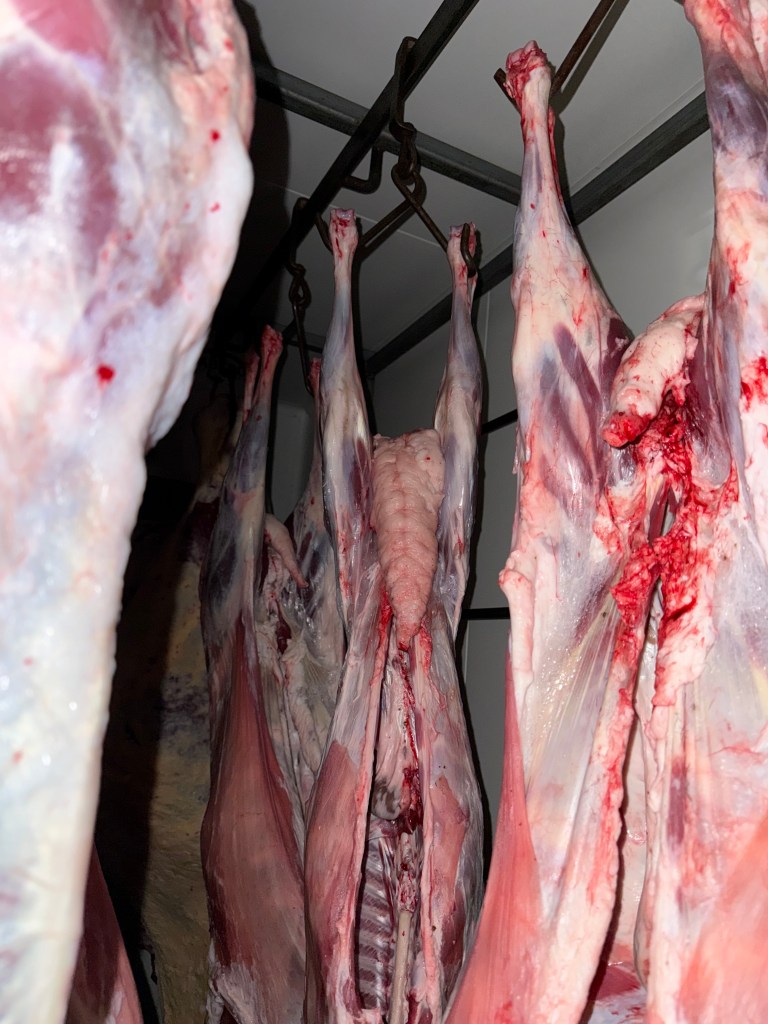
Hang the Damara carcass in a coolroom – or as I use now just a big fridge with no shelves and just a reo bar at the top to hang it from. I put a bottle of water with the lid off, or any container will do, just for added moisture. I usually find after 5-6 days it’s ready to process. Processing your carcass once you’re happy with its hanging time is as simple as the kitchen bench top with either a plastic or wooden cutting board. The reciprocating saw can split the carcass into your three basic sections – forequarter, loin and hindquarters. The legs are easy enough to split in half, crack the shank about 4-5” down so it can fit in an oven tray easier. Same for the front section, hold a shank in one hand and carefully cut down the backbone until it’s halved. Trim off any fat, etc, that’s not needed. Loins are best turned over and run a knife down each side of the backbone, then flip it back over and cut it in half following the cut you made. Once the backbone is out you can knock off the flap or brisket and you are left with the loins and cutlets.
Mark, you have made this sound very doable … what are the most common mistakes people make the first few times?
The most common mistakes I find are people rushing, thinking they know what to do because they watched grandad do it when they were a kid, or it can’t be that hard, it’s only a sheep. The easiest spot to ruin a carcass is slicing through the guts and having that all over the meat, same for not clearing out the chute and having that taint the meat. Like anything practice makes perfect!
How long does the process take?
The whole process shouldn’t take an hour. Half an hour from standing in a pen to hanging in the chiller is pretty good going. But like I said practice makes perfect! No real rush and don’t put in all the effort of raising it, etc, to ruin it by trying to be a super butcher.
Mobile Butchers
Mobile butchers have operated in Australia for decades now, with reports of rising demand going back to at least 2014. In 2020, the ABC published a piece reporting on the increase in Australians raising their own animals for meat, and on the mobile butchers who were run off their feet. Tasmanian farmer and chef Matthew Evans said that more people with small patches of land were raising animals, and an experienced mobile butcher in Central Victoria said he had seen a rise in people without farming backgrounds giving it a go.
Here in the Southern Highlands, we are lucky to have a fantastic local butcher who also operates a mobile service. Working as a professional butcher for close to two decades, he brings a wealth of experience and professionalism to the job. Asked why he started his mobile butcher service, he said: “It all started when I’d bought all the gear … and as soon as people found out I had the gear and coolroom it all kicked off”. On the advantages of a mobile butcher, he says: “Main advantages of home kills are traceability and low stress levels on the animals”. Traceability is an important point that can be overlooked. When you use a mobile butcher, you know the animal you had butchered is the one you receive as the end product, as the carcasses are hung in the mobile coolroom that usually stays on your property. Experience matters too. In NSW, animals must be slaughtered by people with the skills and training to do so humanely, and the RSPCA has said that experienced operators of mobile slaughter could eliminate stress, though the killing itself must still be done humanely.
On what people should expect, and whether a mobile butcher beats doing it yourself, he said: “What you should expect and the thing that makes a mobile butcher better then doing it yourself is minimal waste of your animal as they should know how to get the most out of any animal”. Many people are now recognising the importance of minimising food wastage for both financial and ethical reasons, so using a professional butcher instead of attempting it yourself addresses this concern. A mobile butcher can also provide all the cuts you would recognise and enjoy, in comparison to a potential amateur and basic job on your own. Using a mobile butcher also just simply takes a lot of physical, difficult and technical work out of your hands and into the hands of a professional, and is a service that is arguably very worth the cost.
On whether he has seen the industry growing, he said: “I feel like the industry is growing more as everyone is wanting to become more aware of where their food comes from and also more involved in where their food comes from”. The wider trend on personal food growing and production backs him up. A 2024 Australia Institute survey found that 45% of Australians, around 9 million people, grow some of their own food, and most of them do it in their own backyard. Of those who don’t, almost two thirds said they were interested in starting, rising to almost four in five among 18 to 39-year-olds. On the land itself, there has been an increase of hobby farms over the past five years. Much of this growing is vegetables, and Australian research on backyard chickens found they are kept mainly for eggs rather than meat. But the same shift is reaching livestock. Analysis of farm data to 2015-16 pointed to a spread of small-scale “hobby” cattle grazing, and a Queensland meat processor has reported an increase in private processing for people who have cattle and want them for their own consumption. It’s the same pull he describes: wanting to be more involved in where food comes from.
If you want to step away from the industrial meat system but don’t have the skills for the last step, you don’t have to go it alone. A hardy, easy-care breed like the Damara, with its lean, flavourful meat, makes raising your own much more manageable, and there may well be a mobile butcher near you who can come to your property with the professional skills and equipment to make it happen.
Damara Recipes
Coming Soon!!
Like to know even more about the breed? Have a look at the About The Damara sections, or head to Information for New Shepherds for a quick introduction to sheep husbandry.

